Electric Toys
 A lot of people remember the Soviet electronic toys, "Well, wait," which served as both the watch and the alarm. But it turns out that toy was the ones I've never seen in my childhood.
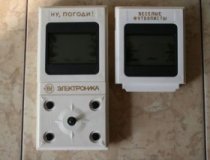
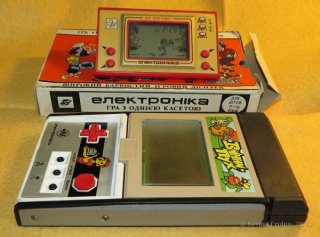
I'll start with the IM-12 Electronic, Winnie Puk.
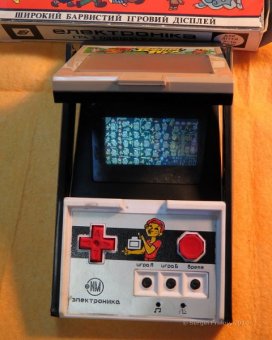
In the picture, you can compare the sizes to the usual game of "Well, wait!" This game was conceived as an alternative to playing "Well, wait!" with shifted cartridges and other more powerful microprocessor. Unlike "Well, wait!" in this game, the screen works for light. Before the game, we need to unlock the game console and adjust the light source.
On the screen, the player looks through the mirror.
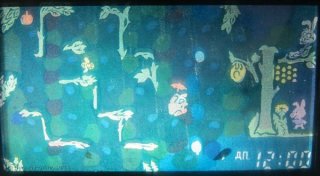
The meaning of the game is to pass the route, avoid meeting the bees and collect all things.
 IM-26 electric vehicles with replacement screens
Released from late 1988. There were two top (screen) and one lower part in the kit. The games were the same as the previous Electronics.
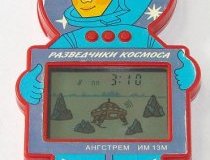
Space detectors
The most recent version of the game we've got
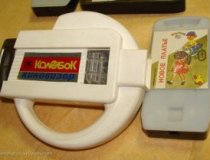
Kolobok
The game is quite simple - a cartoon and cartoon machine.
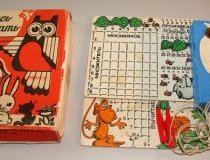
Learn to count
A square battery is placed inside the sow. Charts have examples of stocking/reading and multiplication/response.
One end of the probe has to be touched at the intersection of the first and second judgings and the second end to contact under the right answer.
If the answer's true, the eyes of the sympathetic clamp were burned.
 Radio-controlled machine
Yellow futuristic car, rolli. There was a switch from the bottom to the I.C., which included the rear wheels. After which the machine was standing and moving exclusively forward. The button on the remote was the only function that was driving back and left. Maybe not very rare, but I didn't have one, and I didn't see it on sale.
Young electronics
Tyr electronic
Teleconstructor
Telequi-video Electrical Telecommunications
Videosport Telequin Games
Modulian radar
Child negotiating device
Children ' s Computing Vehicle
Children's toys.
Several chess computers
"Shachmatic partner" with liquid crystal indicator
SC-1
Each cell of the board has contact. To make a move, you're gonna have to press the figure on the cage from where to go, and then press the cage of "where." The computer shows its moves in the same way, but it lights at the turns of the lights on the edges of the board and the position of the figure is determined by the intersection of the lighted lights.